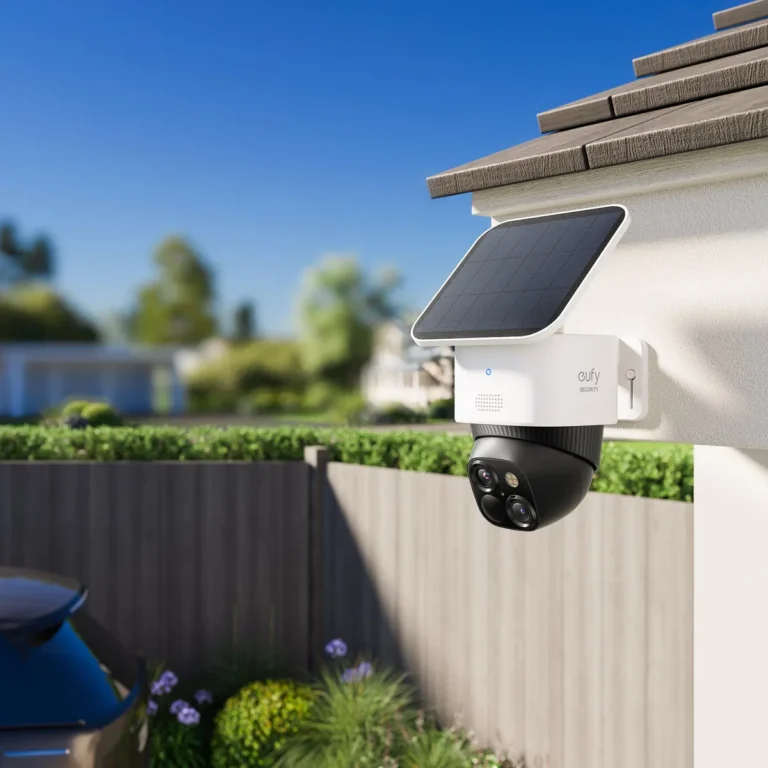
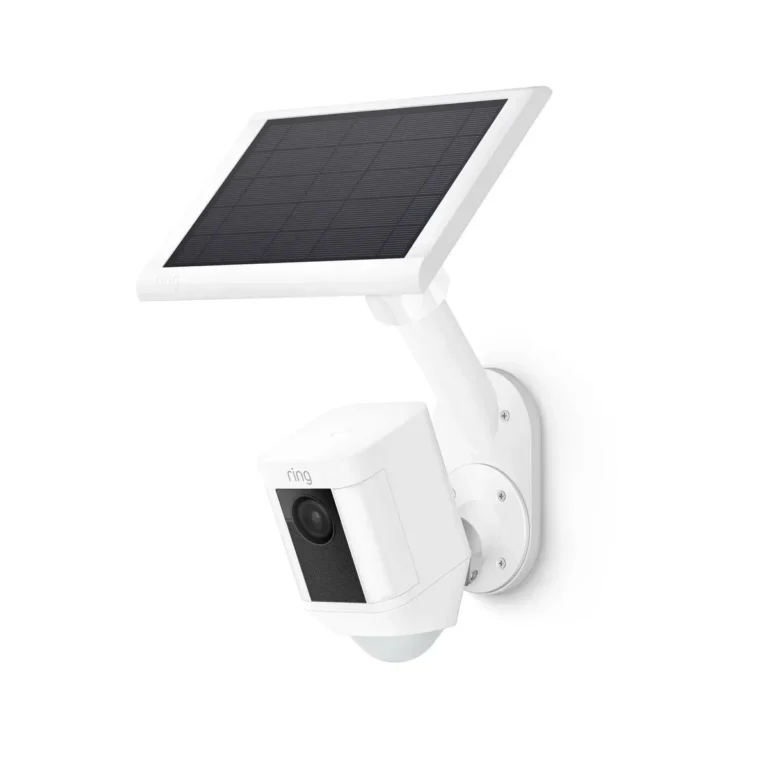
How Far Can a Solar Security Camera See at Night?
How far can a solar security camera see at night? The honest answer depends on technology, environment, and what you actually need to see. Manufacturer specs often list infrared (IR) distances that sound impressive on a box, but those numbers rarely translate to useful footage.
In our research across camera specifications and aggregate user feedback, IR detection distances range from 20 to 65 feet, while actual facial recognition typically stops between 10 and 25 feet. As of 2026, that gap hasn't changed much, and it still trips up a lot of buyers. Let's break down why.
Quick Answer
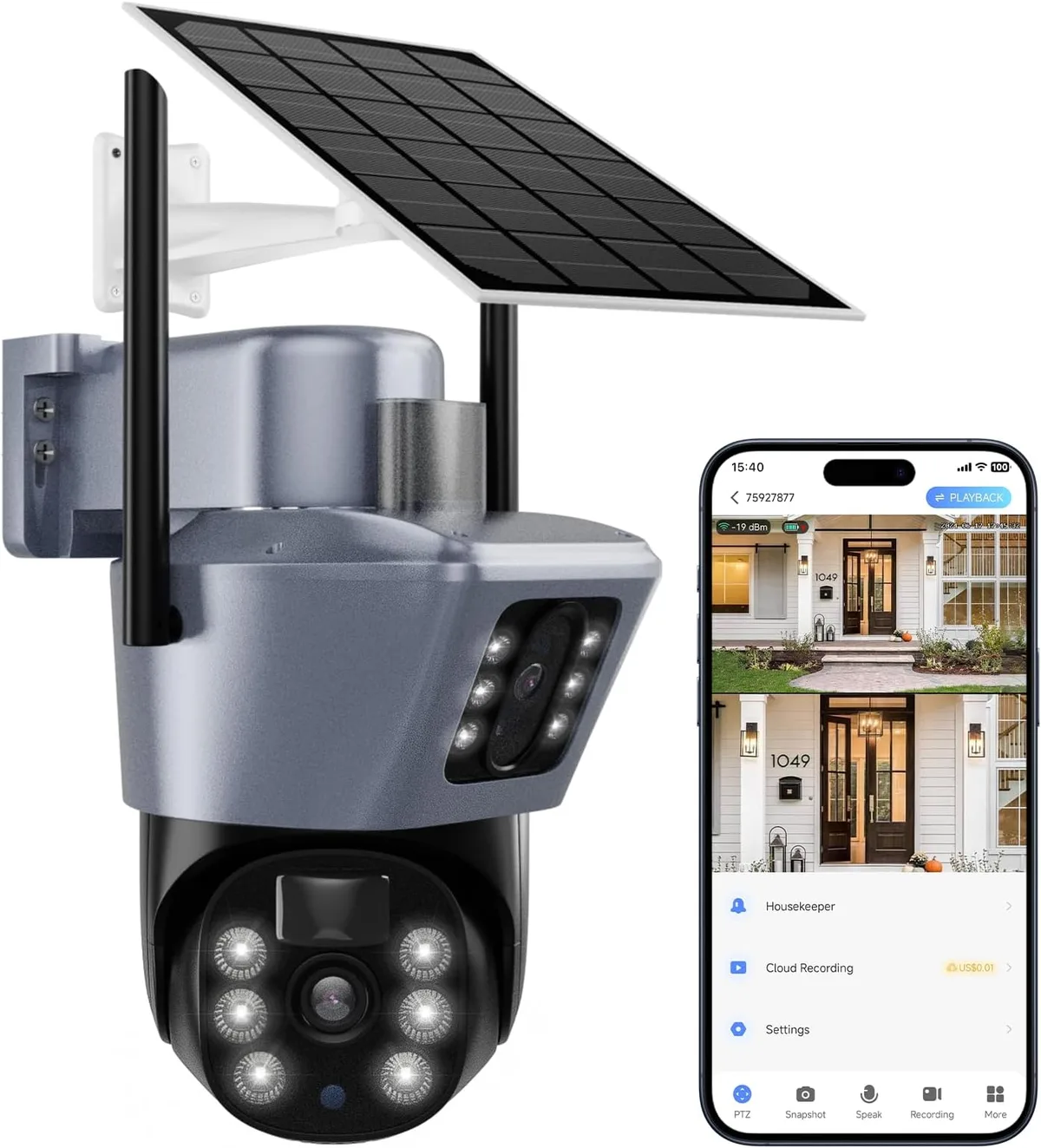
A solar security camera sees between 20 and 65 feet at night. IR cameras detect motion from 30 to 65 feet away. Identifying faces usually needs 10 to 25 feet of clear space.
Starlight sensors extend usable night images to 50 to 98 feet.
The Night Vision Range Trap: Why "65 Feet" Doesn't Mean What You Think
Here's the dirty secret of solar security camera marketing. Manufacturers list a maximum IR range, often 30 to 65 feet, right on the packaging. That number sounds great.
It means almost nothing useful in practice.
A camera can "see" a motion event at 50 feet, but the footage at that distance is usually a dark silhouette. You'll know something was there. You won't know who or what it was.
Aggregate user reviews consistently report this frustration. People install a camera rated at 65 feet, then discover that faces at 40 feet are unrecognizable blobs. The IR LEDs light up the scene, but the sensor can't resolve enough detail at that distance.
Think of it like driving with headlights. You can see that a car is approaching from far away. That doesn't mean you can read its license plate at 100 feet.
If you're buying a solar camera for security, the real question isn't how far the IR reaches. It's how far you need clear, identifiable footage. Most homeowners need good facial or vehicle recognition within 15 to 30 feet of the mounting position.
Detection Distance vs. Identification Distance: The Two Numbers That Actually Matter
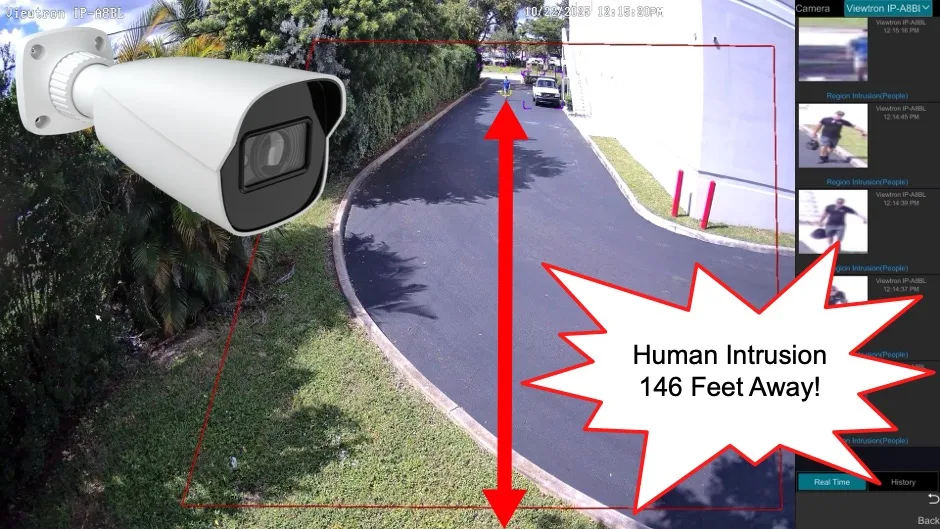
These two terms get confused constantly, and the difference matters more than almost any other spec.
Detection distance is how far a camera can register that something moved. It uses a passive infrared (PIR) sensor or pixel-change algorithms to trigger a recording or alert. This distance is typically 25 to 40 feet for most consumer solar cameras.
Identification distance is how far the camera can produce footage detailed enough to recognize a face, read a license plate, or identify a vehicle make and model. This is the number that actually protects you.
| Distance Type | Typical Range | What You See |
|---|---|---|
| PIR motion detection | 25 to 40 feet | Something moved, but no detail |
| IR detection | 30 to 65 feet | Dark shapes, blurry figures |
| IR identification | 10 to 25 feet | Recognizable faces and objects |
| Color night vision identification | 25 to 50 feet | Clear faces, readable plates |
| Starlight sensor identification | 30 to 98 feet (high-end) | Usable detail in low light |
The gap between detection and identification is roughly a factor of three to five. Your camera might alert you at 40 feet and identify the person at only 12 feet. That's not a defect.
It's physics.
Resolution plays a huge role here. A 1080p camera at 30 feet struggles with facial detail. A 4K camera at the same distance does much better because it captures more pixels per subject.
Lens focal length matters too. A wide-angle lens (typically 110 to 130 degrees) covers more area but compresses detail at distance.
Understanding this distinction will save you from buying the wrong camera. Always look for identification ratings, not just detection claims.
What Really Determines How Far a Solar Camera Sees at Night
Four factors drive night vision performance more than any marketing spec.
The Sensor
Sensor size is the single biggest factor in low-light performance. Larger sensors capture more light. Most consumer solar cameras use a 1/3-inch sensor.
Better models use 1/2.8-inch or even 1/2-inch sensors.
Starlight sensors are the premium tier. They work at light levels as low as 0.001 to 0.02 lux, compared to roughly 0.1 lux for standard IR sensors. The result is footage that stays usable in near-total darkness.
The Night Vision Technology
IR night vision uses invisible infrared LEDs to illuminate the scene. It produces black-and-white footage and works out to about 30 to 65 feet for detection. Identification drops to 10 to 25 feet.
Color night vision relies on the sensor's ability to capture ambient light without IR assist, or uses a white LED spotlight. Without a spotlight, color night vision is limited to well-lit areas. With a spotlight, useful range extends to 25 to 50 feet.
Starlight sensors sit between these. They capture real color in low ambient light without IR. Think moonlit driveways, porch lights, and street-lit alleys.
The Environment
Light pollution, reflective surfaces, and vegetation all change how far your camera effectively sees. A camera on a white wall reflects more IR light and appears brighter. Same camera pointed at dark vegetation appears almost black at the same distance.
Resolution and Lens
Higher resolution directly extends identification range. A 4K camera identifies faces roughly twice as far as a 1080p model at the same distance. Lens aperture matters too.
A wider aperture (lower f-number like f/1.6) gathers more light than a narrow one (f/2.8).
Per the National Institute of Standards and Technology, sensor sensitivity and image resolution are the two measurable variables that most directly predict usable surveillance footage quality in low-light conditions.
Night Vision Technology Compared: IR, Starlight, and Color Night Vision
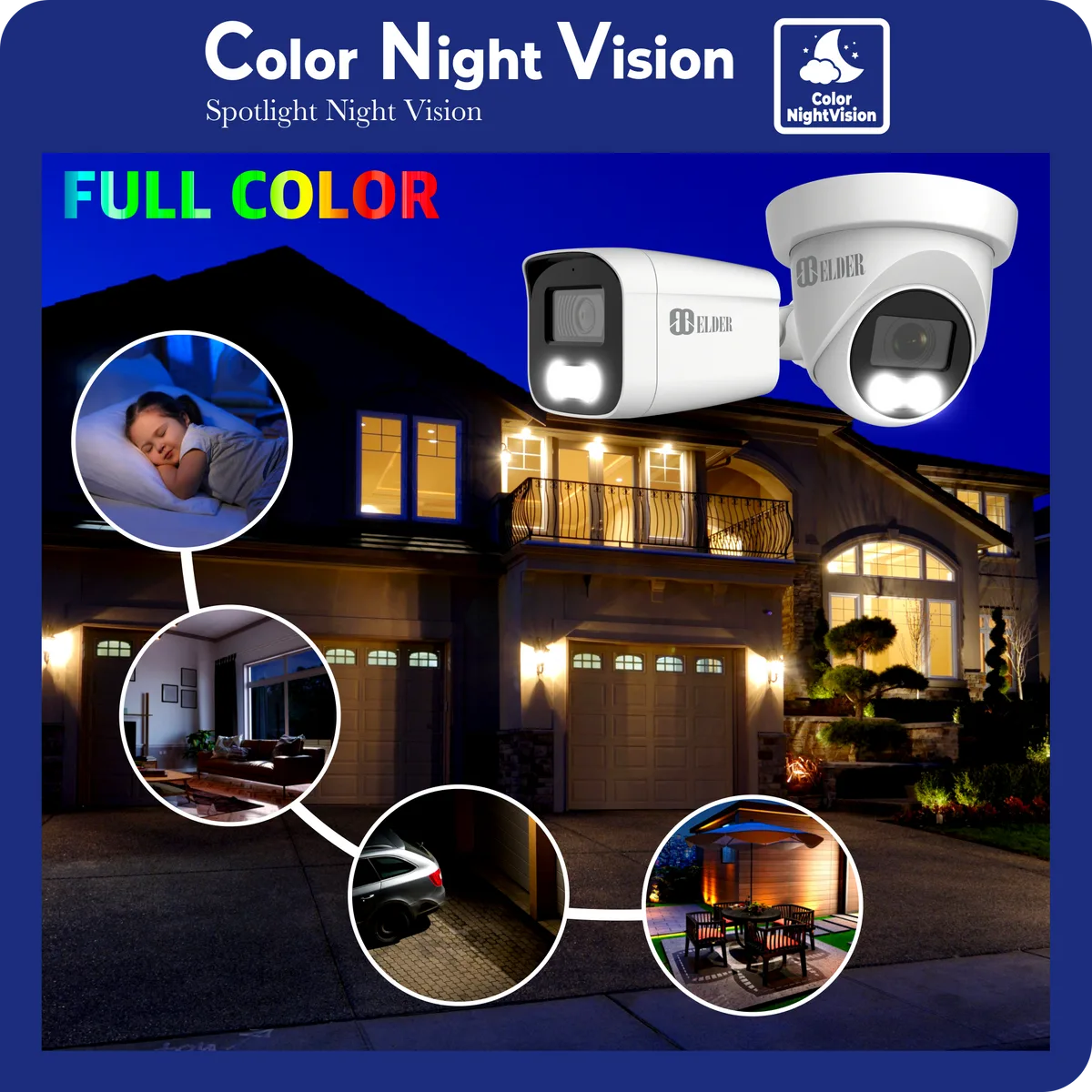
Here's how the three technologies stack up in real-world conditions.
| Feature | IR Night Vision | Starlight Sensor | Color Night Vision |
|---|---|---|---|
| Output quality | Black and white | Full color in low light | Full color, may need spotlight |
| Effective detection range | 30 to 65 feet | 30 to 98 feet | 25 to 50 feet |
| Facial identification range | 10 to 25 feet | 20 to 40 feet | 25 to 50 feet |
| Minimum light needed | Near zero | Very low (0.001 to 0.02 lux) | Requires ambient or LED light |
| Solar power demand | Low | Low | Higher if spotlight is active |
| Best for | Pure darkness, rural areas | Mixed lighting, suburban yards | Well-lit areas, close-range detail |
If your camera sits in true darkness with no ambient light, IR is your baseline. It's affordable, dependable, and requires minimal solar power. Just don't expect it to identify faces beyond about 25 feet.
If you have any ambient light at all, even faint streetlight or moonlight, a starlight sensor delivers dramatically better footage. For solar-powered setups specifically, starlight sensors are the best balance of performance and power efficiency.
Color night vision with a built-in spotlight gives the most recognizable footage, but the spotlight drains your solar battery faster. During long cloudy spells, that battery drain becomes a real problem.
Manufacturer documentation from major solar camera brands confirms that all three technologies work reliably as long as you match the technology to your actual environment rather than the marketing range on the box.
Real-World Night Ranges: What You'll Actually See at 10, 30, and 50 Feet
Specs are one thing. Practical results are another. Here's what footage typically looks like at different distances with common solar camera configurations.
At 10 to 15 Feet
This is the sweet spot for almost any solar security camera. Even a basic 1080p IR model captures recognizable faces and readable details at this range. If you're mounting a camera near a front door or garage entrance, this distance gives you reliable identification footage every time.
A starlight sensor camera at this range produces full-color footage that rivals daytime clarity in most cases.
At 25 to 30 Feet
Quality starts to drop for IR-only cameras. You'll see that a person is present and roughly what they're wearing. Facial details become difficult.
A 4K resolution camera with good IR or starlight performance still identifies people here.
This is also the outer limit where PIR motion detection remains reliable on most consumer solar models.
At 40 to 50 Feet
Expect dark shapes and motion alerts. Identification requires either a starlight sensor, a powerful LED spotlight, or 4K resolution with a favorable lens. Even then, results depend on what the subject is wearing and whether ambient light exists.
A camera at 50 feet in total darkness will trigger and record. You'll see the motion in the footage. You won't see enough to identify anyone.
The Practical Takeaway
If you need to identify faces and vehicles at night, mount your camera no more than 20 to 30 feet from where you expect activity. Mount it 2.5 to 3 meters high and aim it down 15 to 30 degrees. For larger areas, add a second unit closer to the point of interest rather than hoping one camera handles the whole perimeter.
Common Mistakes That Ruin Solar Camera Night Performance
Ignoring the Detection-to-Identification Gap
The biggest mistake is buying a camera based on its IR detection range alone. A camera rated at 65 feet will trigger a recording at that distance. It won't identify anyone at that distance.
If you don't account for this gap, you'll get alerts you can't use.
Mounting the Camera Too Far from the Action
If your front door is 40 feet from where you mount the camera, IR footage of anyone at that door will be unrecognizable. Place the camera within 15 to 30 feet of the spot where people actually arrive.
Expecting Color Night Vision in Total Darkness
Color night vision needs some light. In pitch darkness, even the best solar camera falls back to IR mode. If your mounting location has no ambient light, either add a spotlight or plan for IR footage.
Skipping Firmware Updates
Manufacturer firmware updates frequently improve low-light performance, motion detection accuracy, and battery management. Aggregate reviews from brands like Eufy and Reolink show measurable improvements in night footage quality after certain updates. Check for updates monthly.
Draining the Battery with Spotlight Mode
If your camera uses a white LED spotlight for color night vision, constant nighttime activity can drain the battery faster than the solar panel recharges it. During winter months with short daylight hours, this becomes a real problem.
Setting Up Your Solar Camera for Maximum Night Range
Getting the most distance out of your solar security camera at night comes down to mounting, configuration, and maintenance.
Mount at the Right Height and Angle
Mount the camera 2.5 to 3 meters high. Aim it down at a 15 to 30 degree angle toward your entry point. Too steep, and you miss faces at distance.
Too flat, and the IR reflects off distant surfaces, washing out nearby footage.
Position the Solar Panel Correctly
Point the panel south in the northern hemisphere for maximum charging. Keep it unobstructed. A shaded panel means a drained battery, which means missed nighttime recordings.
Manufacturer specs confirm that 5 to 8 hours of direct sunlight fully charges most consumer solar camera batteries.
Tune Motion Detection Settings
Set PIR sensitivity to medium rather than high. High sensitivity causes false triggers from blowing branches, passing cars, and animals. These false alerts also drain the battery and fill your storage with useless footage.
Clean the Lens and IR Panel Monthly
Dust, pollen, and spider webs accumulate fast on outdoor cameras. A dirty IR LED panel scatters light and reduces effective range significantly. Wipe the lens and LED surface with a microfiber cloth every few weeks.
Test Night Performance Before You Trust It
After installation, check the app feed after dark. Look at footage at 10, 20, and 30 feet to see what you can actually identify. Adjust the angle, sensitivity, or mounting position based on what you see, not what the box promised.
| Setup Step | Key Action | Impact on Night Range |
|---|---|---|
| Mount height | 2.5 to 3 meters | Better downward angle for face capture |
| Mount angle | 15 to 30 degrees down | Reduces IR washout from walls |
| Solar panel position | South-facing, unobstructed | Keeps battery charged overnight |
| PIR sensitivity | Medium setting | Fewer false alarms, longer battery life |
| Lens cleaning | Every 2 to 4 weeks | Prevents IR scattering and blur |
Winter brings shorter days and more cloud cover. Your solar panel produces less power, and batteries run colder, which reduces their effective capacity. If you're in a northern climate, plan for this.
Some owners add a small secondary panel or switch to a hybrid battery setup to maintain reliable overnight operation. Per the Department of Energy, solar panel output drops significantly below standard test conditions, especially when ambient temperatures fall.
Solar Security Camera Night Vision FAQs
Can a solar security camera see in total darkness?
Yes, a solar security camera can see in complete darkness using infrared (IR) night vision. IR LEDs emit light the human eye can't see, and the sensor captures footage based on that light. Detection typically reaches 30 to 65 feet in true darkness, but identification drops to 10 to 25 feet.
For clearer footage without ambient light, look for a camera with powerful IR and high resolution.
How do I know if my solar camera can identify faces at night?
Check two specs: sensor size and resolution. A 1/2.8-inch or larger sensor paired with at least 2K resolution reliably identifies faces within 15 to 25 feet at night. Starlight sensors push that range further, up to 30 to 40 feet.
If the spec sheet doesn't list sensor size, treat the identification range as unknown and mount the camera closer to entry points.
Does a spotlight camera work better than IR for night vision?
A spotlight camera produces full-color footage that's far more useful for identification than IR's black-and-white output. With an active spotlight, useful range extends to 25 to 50 feet. The tradeoff is battery drain.
Motion-triggered spotlight mode preserves battery life while still giving you color footage when it matters most.
How does weather affect solar camera night vision performance?
Rain, fog, and snow reduce effective night vision range by scattering IR light and coating the lens. Humidity causes condensation behind the lens, which blurs footage. Cold weather reduces battery capacity.
Use a camera with an IP66 or IP67 rating for weather resistance, and check the lens for condensation during seasonal temperature swings.
Can solar cameras work without Wi-Fi at night?
Yes. Solar security cameras with local storage (microSD card) continue recording at night without a Wi-Fi connection. Footage saves locally and uploads to your device when the connection returns.
For real-time night monitoring in rural areas, look for cellular-enabled models that use a SIM card.